
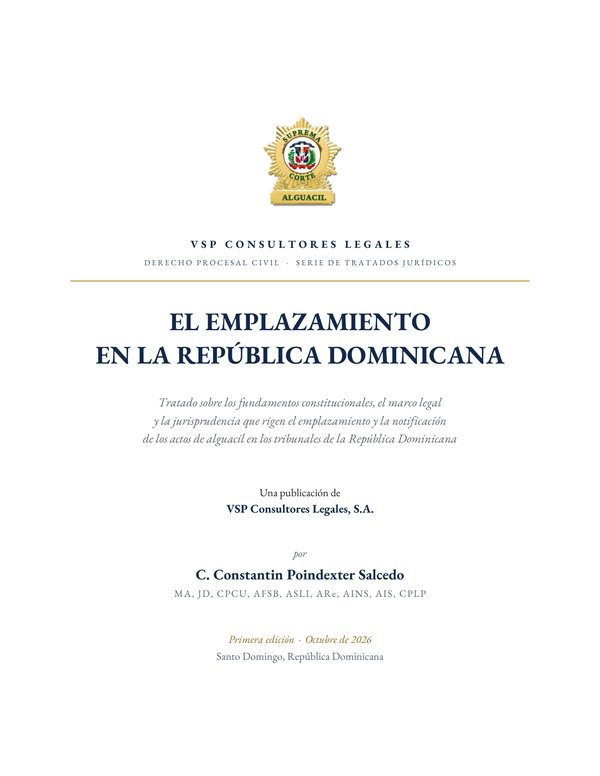
About the work
Every civil action in the Dominican Republic is born as an act of a bailiff. Unlike systems of Anglo-American inspiration, where the action begins with the filing of a pleading with the clerk and the summons is a document the clerk issues afterward, Dominican civil procedure, a direct heir of the French system, begins with service itself: the acto de emplazamiento, drafted at the plaintiff's request and executed by a ministerial officer, is at once the complaint, the summons and the first act of the proceeding. Everything that follows depends on its regularity.
This treatise sets out in a single volume the law governing the summons in the Dominican Republic: the constitutional foundations the 2010 Constitution brought into civil procedure; Title II of Book II of the Code of Civil Procedure, Articles 59 to 74, with the reforms since 1884; the nullity regime of Law No. 834 of 1978; the bailiff's statute under Law No. 821 on Judicial Organization; the special rules for serving the State, municipalities, companies, persons with no known domicile and persons residing abroad; and the Republic's accession to the 1965 Hague Service Convention, in force for the country since October 1, 2024.
The work is at once academic and practical. Each chapter moves from principle to rule and from rule to application, and most close with observations on forensic practice as shaped by the case law. Where Dominican law departs instructively from the law of Puerto Rico or the U.S. federal forum, the text says so, because many disputes unfold simultaneously on both sides of the Mona Passage. The treatise is written in Spanish; this page summarizes its contents for English-speaking readers.
Who it is for
- Dominican litigators, who will find the complete regime of form, time limits, modes of service, proof and nullities, with the case law of the Supreme Court of Justice and the Constitutional Court.
- Bailiffs (alguaciles), with a chapter on the ministerial officer's statute, territorial competence, disqualifications and liability, and standards of professional practice.
- Counsel in Puerto Rico and the United States who must serve process in the Dominican Republic or seek recognition of Dominican judgments, with systematic contrast against Puerto Rico Rules 4.3, 4.4 and 4.7 and Federal Rule 4(f).
- Judges, students and scholars of civil procedure, with a table of authorities, historical development and constitutional analysis.
Contents
Part I · Foundations
- The constitutional function of the summons
- The legal architecture
- Historical development of the summons in the Dominican Republic
Part II · The act of summons
- Form and content of the act of summons
- Time limits of the summons
Part III · The alguacil
- The alguacil as ministerial officer
Part IV · Modes of service
- Service on natural persons
- Service on minors and incapacitated persons
- Service on companies and legal entities
- Service on the State and public bodies
- Special regimes
- Service on persons with no known domicile
- Service on persons abroad
Part V · Proof, nullities and consequences
- Proof of service
- Nullities of the summons
- Default and challenges to the judgment
- Subsequent notifications and digital communications
- Standards of practice for professional service
Includes a preface, conclusion, table of authorities (Constitution, codes and statutes, treaties, decisions of the Constitutional Court and the Supreme Court of Justice, decisions of the U.S. Supreme Court, and Puerto Rico rules cited by way of contrast), and notes on the author and publisher.
Highlights
- The summons as the act that opens the proceeding, and effective judicial protection under Articles 68 and 69 of the Constitution.
- Articles 59 to 74 of the Code of Civil Procedure and the rule that there is no nullity without prejudice (Law No. 834 of 1978).
- Courtroom and ordinary bailiffs, territorial competence and public faith under Law No. 821.
- Service on persons with no known domicile (Art. 69, para. 7) and the diligence standard set by the Supreme Court of Justice and the Constitutional Court (SCJ-PS-25-1266; TC/0265/26).
- Service on persons abroad (Art. 69, para. 8), the 1965 Hague Service Convention, the Dominican Central Authority and its declarations, and the consequences for litigants in Puerto Rico and the United States.
- Law No. 339-22 and the digital judicial mailbox.
- A checklist for counsel before executing a summons.
How to cite
Poindexter Salcedo, C. Constantin. El Emplazamiento en la República Dominicana: tratado sobre los fundamentos constitucionales, el marco legal y la jurisprudencia que rigen el emplazamiento y la notificación de los actos de alguacil. 1st ed. Santo Domingo: VSP Consultores Legales, S.A., 2026. Available at https://alguacilrd.com/publicaciones/el-emplazamiento-en-la-republica-dominicana/
About the author
C. Constantin Poindexter Salcedo, MA, JD, CPCU, AFSB, ASLI, ARe, AINS, AIS, CPLP, is an attorney and partner at VSP Consultores Legales, S.A. (VSP Law, PLLC), and founder of Diligencias Legales de Puerto Rico and of the investigative firm Poindexter Global Intelligence. A thirty-year veteran of surety and reinsurance underwriting, he is the founder of Surety One, Inc. and chief executive of Janus Assurance Re, a reinsurer domiciled in the Dominican Republic. He is the author of The Contractor's Guide to Surety Bonds (NewSouth Books) and of treatises on service of process in Puerto Rico and North Carolina. He practices from offices in Santo Domingo, San Juan and Raleigh, and writes in Spanish and English.
About the publisher
VSP Consultores Legales, S.A. (Villar, Sánchez y Poindexter) is a law firm headquartered in Santo Domingo with offices in Raleigh and San Juan, assisting Dominican and foreign clients in civil and commercial litigation, foreign investment, regulatory compliance and real estate. As part of its commitment to the dissemination of Dominican law, the firm publishes open-access legal guides and treatises.
Copyright 2026 VSP Consultores Legales, S.A. Brief quotation with attribution is permitted. The work is distributed for academic and informational purposes and is not legal advice.